

Balcony Leak Detection & Investigation
Comprehensive balcony leak investigations assessing waterproofing, drainage, cladding and adjoining building elements.
Balcony Leak Detection & Investigation – More Than Just Waterproofing
A leaking balcony isn’t always a waterproofing membrane problem. Identifying the source of water ingress requires an assessment of the complete balcony construction and its interaction with the surrounding building elements.
At Independent Building Inspections Victoria (IBIV), we undertake comprehensive balcony leak investigations to identify the source of water ingress, assess contributing building defects and determine the appropriate course of action for rectification or dispute resolution.
What’s the Difference Between a Plumber and a Building Consultant?
A licensed plumber may be engaged to investigate leaks associated with balcony drainage, waste pipes, rainwater outlets, flashings and other plumbing installations.
However, many balcony leaks originate from defects unrelated to the plumbing installation or the waterproofing membrane itself.
Water can enter through defective external cladding, inadequate parapet cappings, incorrectly installed doors and windows, unsuitable balcony drainage arrangements, defective tiling systems and deficiencies at the junctions between adjoining building elements.
At IBIV, we investigate the balcony as a complete building system, rather than assessing the waterproofing membrane or plumbing installation in isolation.
Our investigations consider the interaction between waterproofing, tiling, drainage, external cladding, balustrades, parapets, doors, windows and the adjoining building structure to identify how and why water is entering the building.
While defective plumbing installations can contribute to balcony water ingress, our experience indicates that plumbing defects account for a relatively small proportion of the balcony failures we investigate.
What Does Our Balcony Leak Investigation Include?
Depending on the balcony configuration, accessibility, construction type and nature of the reported leak, our assessment may include:
- Balcony Layout and Construction – Assessment of the balcony configuration, structural substrate, adjoining building elements and the suitability of the overall design for managing exposure to weather.
- Waterproofing Membranes – Assessment of accessible and visible waterproofing details, membrane terminations, junctions, penetrations and potential deficiencies in the waterproofing system.
- Floor Grades and Drainage – Assessment of surface falls, ponding, floor waste arrangements, drainage capacity and the ability of the balcony to direct water towards nominated discharge points.
- Overflow Provisions – Examination of overflow arrangements and their capacity to provide an appropriate secondary drainage pathway where required.
- External Cladding and Balustrade Walls – Assessment of cladding installations, junctions, penetrations, cavity drainage provisions and their potential contribution to concealed water ingress.
- Parapet Walls and Cappings – Examination of parapet construction, capping configurations, flashings, junctions and their suitability for preventing water entry into the underlying structure.
- Doors and Windows – Assessment of external door and window installations, sill and threshold details, flashings, drainage provisions and interfaces with the balcony waterproofing and adjoining wall construction.
- Tile Installation and Adhesion – Consideration of tile installation methods, adhesive coverage, substrate suitability, movement joints and their potential influence on drainage, water retention and waterproofing performance.
- External Wall Cavities and Drainage – Assessment of the capacity for water entering external wall systems to drain appropriately without becoming trapped or migrating into adjoining building elements.
- Floor Wastes and Puddle Flanges – Assessment of the floor waste configuration and the adequacy of the connection between the waterproofing membrane and puddle flange, where this can be established.
- Building Product Installation Requirements – Consideration of relevant manufacturers’ installation instructions, product specifications, certificates of conformity and the compatibility of adjoining construction materials and systems.
- Applicable Building Standards and Regulations – Assessment against relevant Australian Standards, the National Construction Code (NCC) and other applicable regulatory requirements, having regard to the construction and approval history of the subject property.
Advanced Leak Detection and Diagnostic Equipment
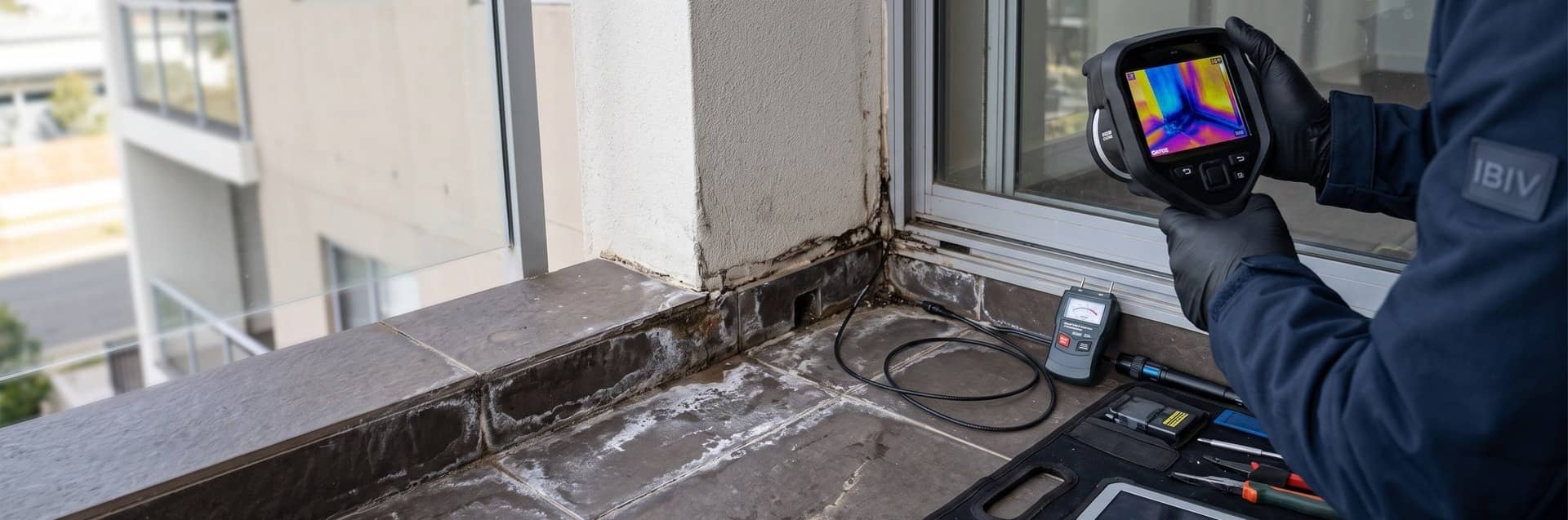
IBIV utilises specialised inspection equipment to assist in identifying concealed moisture, tracing water migration and investigating areas that would otherwise be difficult to access.
Our investigation methods may include:
- Thermographic Imaging: Thermal cameras assist in identifying temperature variations potentially associated with concealed moisture and water migration.
- Non-Destructive Moisture Detection: Specialised moisture meters assist in identifying and mapping elevated moisture levels within building materials without unnecessary damage.
- Destructive Investigation: Where authorised and necessary, targeted opening-up works may be recommended or undertaken with appropriately qualified trades to verify concealed construction details and potential defects.
- Restricted-Access Inspection Cameras: Inspection scopes allow examination of selected concealed cavities and difficult-to-access building elements.
- Thermographic Subfloor Inspection Robots: Specialised robotic inspection equipment assists in investigating restricted subfloor areas, including locations where conventional physical access is impractical.
By combining these methods with an assessment of the balcony’s construction, IBIV can develop an evidence-based understanding of the likely source of water ingress and the contributing defects.
Identifying the Cause – Not Just the Symptoms
Water staining to ceilings below balconies, deterioration of external cladding, damaged internal finishes, mould and moisture within adjoining rooms are often symptoms of an underlying construction defect.
A leaking balcony does not automatically mean the waterproofing membrane has failed.
Replacing the membrane or applying additional sealant may not resolve the problem if water is entering through external walls, doors, windows, parapet cappings or other defective construction interfaces.
Our objective is to establish:
- Where water is entering and how it is migrating through the building.
- Which construction elements are defective or contributing to the leak.
- Whether the identified defects are inconsistent with applicable building standards, manufacturers’ installation requirements and regulatory provisions.
- Whether the waterproofing membrane has failed or water ingress is attributable to other building elements.
- What rectification works may be necessary to address the underlying cause.
- Which contractor, trade or builder may be responsible for the identified defective work, where supported by the available evidence.
Where plumbing defects, including leaking drainage pipework or non-compliant parapet cappings, are identified, IBIV can recommend or assist in arranging further assessment by a suitably qualified licensed plumber.
Apartment Balconies – Private Property or Common Property?
Balcony leak investigations within apartment buildings can involve additional complexities concerning ownership, maintenance obligations and responsibility for defective building elements.
In Class 2 apartment buildings, the distinction between private lot property and common property can be critical when determining who may be responsible for undertaking or funding rectification works.
A balcony may form part of a private lot while adjoining structural elements, external walls, drainage systems or other components may constitute common property.
The location of a defect does not necessarily determine who is responsible for its rectification.
IBIV can assist in assessing the construction elements contributing to water ingress and their relationship to the property boundaries identified in the registered plan of subdivision and relevant title documentation.
This assessment can assist owners, owners corporations and their representatives in understanding the potential responsibilities of the parties involved.
The allocation of legal responsibility may also depend on applicable legislation, building contracts, maintenance obligations and other relevant documents.
From Leak Investigation to Rectification or Building Dispute Resolution
Our services extend beyond identifying the source of a balcony leak.
IBIV can prepare independent inspection reports documenting observed defects, supporting evidence, technical assessments and recommended rectification works.
These reports can assist homeowners, apartment owners and owners corporations when seeking repairs from their builder or contractor, obtaining quotations for remediation or pursuing a building dispute.
Where a dispute cannot be resolved directly, reports can be prepared or upgraded to support the relevant dispute resolution process, including the Building and Plumbing Commission (BPC) and its domestic building dispute resolution services, where the matter is eligible.
Should the matter progress to the Victorian Civil and Administrative Tribunal (VCAT), IBIV can prepare a more comprehensive Expert Witness Report, including technical assessments, proposed rectification scopes and associated costings where required.
Existing investigations and reporting may be incorporated into an upgraded report, reducing unnecessary duplication of work.
Don’t Just Repair the Leak – Understand Why It Happened
Whether you have water entering the apartment below, deterioration of balcony finishes, moisture affecting adjoining rooms or an ongoing dispute with your builder or owners corporation, identifying the underlying cause is essential to achieving an effective and lasting repair.
IBIV provides independent balcony leak investigations, building defect assessments and expert reporting throughout Victoria.
Arrange a Balcony Leak Investigation
Contact Independent Building Inspections Victoria to discuss your balcony leak and the appropriate level of investigation or reporting for your circumstances.
To book a Building Defects Inspection, call Independent Building Inspections Victoria on 0417 555 744, email info@ibiv.au or complete our online enquiry form


Dilapidation Inspection and Reports
BOOK NOW